Thursday, August 28, 2014

Forgiveness


For where two or three are gathered in my name, I am there among them.
                                                                                                Matthew 18:20


Holy moments.

Sitting on the porch on a hot summer afternoon with a trusted friend, (s)he confided to me a dark secret.  My first response was shock. I almost blurted out, “No way! How could you?” At that moment, a soft breeze brushed across my brow, a breeze so soft that I barely felt it, but so noticeable, somehow. The presence of the Spirit danced in that still, soft air. My judgment was suspended, my larynx rendered useless.

“I need to ask for forgiveness,” my friend said, disturbing the suspended wind in the room.   
And the love of God, and the fellowship of the Holy Spirit redeemed that moment. 
Sadness, confusion, guilt, disappointment, and resignation; and then tears of forgiveness sanctified my friend’s cheeks. 

Holy moments.

What holy moments have most touched you this week?

Sunday, June 15, 2014

The Mystery of Grace


Grace conferred on my head by a bishop and eight priests 
as I knelt there praying for the courage to accept God's plans for me.  
I wondered if I'd feel anything at all; anything different. 
And one friend, who had said she could not be there, was among them. 
Not vested. I hadn't seen her arrive. 
But there she was, smiling at my surprise.
And suddenly, I glimpsed................. grace. 

Grace was everywhere that sunny day in June, 
but that one friend who came and surprised me?  
That defined it. 
That ephemeral mystery of God's grace. 
An extended hand, calling on the Holy Spirit to make me into something
impossible for me to do alone; something God asked me to do. 
Grace. 

It does not leave us where it found us. 


Thursday, June 5, 2014

The Donkey

No one thinks much about the donkey that took center stage on Palm Sunday so many years ago, yet Scripture is replete with these "sideliners" who we know were present, yet are pretty much ignored. 

  • I think about the innkeeper in Bethlehem that chilly night so long ago. Did he ever return to the manger? Did he see the multitude of the heavenly host? Or the baby wrapped in swaddling cloths?
  • And I wonder about those guys who circled Jesus and the Samaritan woman at the well with stones in their fists. We know that not one threw a rock, but were they changed? Where did they slink off to when they left the scene, one by one? 
  • And did the bride at the wedding at Cana ever find out that Jesus saved the day when her father ran low on wine? Did she ever thank Jesus? Or ask him how he did it? 

What became of these essential figurines in our faith who don't receive but a passing mention?
And what do they have to tell us about our own humanity? Poet Mary Oliver pointed me to their simple existence with her obscure poem called "The Poet Thinks about the Donkey."   Oliver drew my attention to not just the donkey, but all the others. What wisdom do these sideliners have to impart to us? She made me wonder about my own "donkey-ness" as I seek to deepen my relationships with the Lord and with others. 

What wisdom can the donkey impart to us? Here's the poem: 

                                            The Poet Thinks about the Donkey


                               On the outskirts of Jerusalem
                               the donkey waited.
                               Not especially brave, or filled with understanding,
                               he stood and waited.


                               How horses, turned out in the meadow,
                                    leap with delight!
                              How doves, released from their cages,
                                    clatter away, splashed with sunlight!

                           But the donkey, tied to a tree as usual, waited.
                           Then he let himself be led away.
                              Then he let the stranger mount.

                              Never had he seen such crowds!
                              And I wonder if he at all imagined what was to happen.
                              Still, he was what he had always been: small, dark, obedient.

                              I hope, finally, he felt brave.
                              I hope, finally, he loved the man who rode so lightly upon him,
                              as he lifted one dusty hoof and stepped, as he had to, forward.
-                                                                                                                                    
-                                              - Mary Oliver


Wednesday, May 21, 2014

To Sister Barbara -- Wherever you are . . . .

A long time ago, I took a class, called The Art of Spiritual Direction. It was the first class I took when I returned to graduate school, and I was scared. What if I failed? What if grad school was really for academics, and not for regular everyday sorts of people like me? 
Who did I think I was? 

Classes were wonderful.  Invigorating. Mind bending -- in the best sense of that word. Often, I was paired up with Sister Barbara, a nun from Cincinnati who had spent her adult life ministering in Guatemala.She was back in the US on a 6-month sabbatical, and came to Loyola to take classes. Again I felt those nagging questions. Who was I, to aspire to learning the craft of spiritual direction in the company of one such as this? 

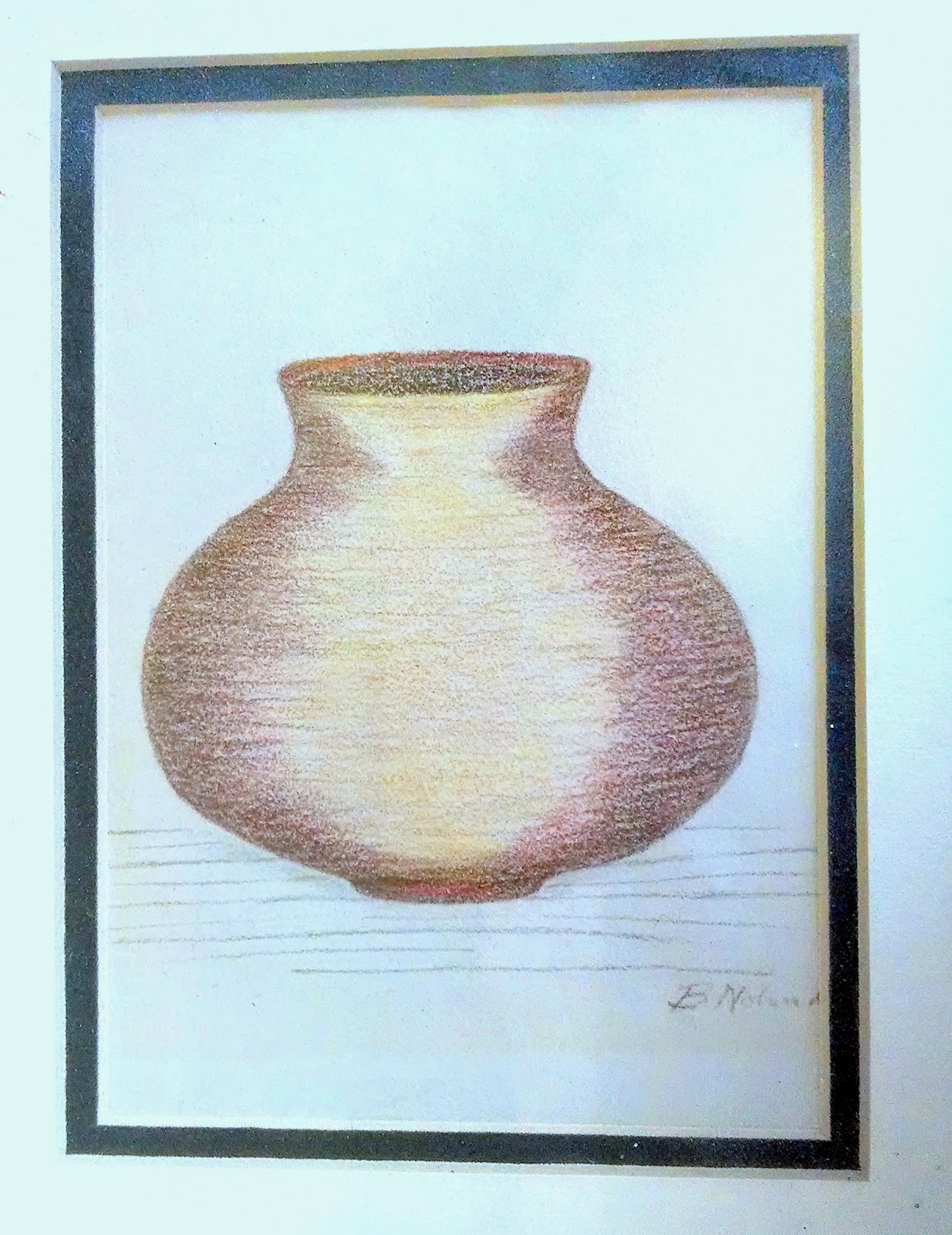
We became friends. Before class and during class breaks, we'd sit and talk and she'd idly sketch.  She sketched the most clear and pristine drawings of the most ordinary objects: the blackboard erasers, someone's notebook, the chipped window sill in that ancient classroom. I marveled at our friendship. Where had her experiences as a celibate Roman Catholic nun living in Central America intersected with mine, an Episcopal suburbanite? She was so pure, so holy, so grace-filled, and here I was: a flappable, distracted American mom picking finger-paint out from under my fingernails during class.  

One image (spiritual direction classes pay very close attention to imagery!) that rested upon my shoulders that semester was an image of myself as a chipped and cracked clay pot holding a bunch of dark gooey stuff inside. One night, after I had shared the image with my classmates in a reflection, we were on a break, and Barb was sketching, and I asked her to sketch my clay pot as I had described it to the class that evening. She asked me more about my clay pot image. What shape was it? How big was it? And, soon, class resumed. 


Two weeks later, I came rushing into class, flapped, late, and muttering about the traffic.  Barb smiled and set a wrapped package on my desk.
It was perfect. 
Too perfect. 

"For you," she said.
"But where are the cracks and the chips and the brown, gooey ooze of my sins?" I protested. 
"This is how God sees you," she replied. 

That picture still hangs in my office, a testament to peace and grace, and quiet calm. 

Thank you Sister Barbara, wherever you are.  


Thursday, May 8, 2014

I Am Coming to You

"I am coming to you."  John 14:18


                                                                                     - August Swanson

In the Gospel, Jesus promises his disciples that even though he is going away for a while, He will not leave them orphaned.  
He promises that He will return to them.
Isn't this all we need?
If we can't trust Jesus, who can we trust?

"I am coming to you." 

We have God's word on it. 
How does God come to you?  

For me, its when I hold a brand new baby, and when the shy smile of a stranger acknowledges that we have shared a common understanding, and when a dew drop on a blade of grass in the early morning catches my eye. Jesus comes to me in the Holy Eucharist, when beautiful music deepens my grasp of life, or when an adult child calls, "just to check in."  In other words, Jesus comes to me in the everyday course of life. And still I am surprised. 

How does He come to you?


Tuesday, March 11, 2014

Trust

The Scripture
Jesus said, "Do not let your hearts be troubled. Believe in God, believe also in me.”
                       John 14:1


The Whispering
Jesus has spelled it all out. He is going away. He has admonished his friends not to worry, but Thomas shouts out, "Lord, we do not know where you are going. How can we know the way?"

Anxiety seems to be a part of our human condition, yet time and again throughout scripture, angels, prophets and Jesus himself exhort us not to be afraid. How might our lives change if we struck anxiety out of our daily life? What if we simply believed that there is indeed a way into the unknown future and that we will be able to find it? 


What if?

Monday, December 16, 2013

Prepare the Way!


A voice cries: “In the wilderness prepare the way of the Lord, 
               make straight in the desert a highway for our God.     Isaiah 40:3

This is one of the Daily Office readings appointed for today in this second week in Advent. 

On a trip to the Holy Land last year, I was aghast at the vastness of the Judean Wilderness.  Yet it was from near this very place that Isaiah wrote, “Prepare the way for the Lord, make straight in the desert a highway for our God.”  


It is hard work to make straight paths in the desert. The land is inhospitable. The day I took this photograph, it was 114 degrees outside – and very dry. Construction crews are not willing to work out here. The single road is ancient, the same one Isaiah would have used. It curves and winds through paths of least resistance.

Advent invites us to this work. If we look at the parched desert as a metaphor for our lives, we are called to prepare a way for the Lord, to prepare a place for God to reside in the midst of our lives, as parched and cluttered and messy as they may be. Advent begs us to make a hospitable place in our lives for God.

How can we create an oasis for God in our lives? Prepare a way! 


Tuesday, December 10, 2013

Thomas Merton December 10th


“Peace Amidst Chaos” by Timothy Mietty


Today, the church remembers Thomas Merton, a contemplative Trappist monk and prolific writer. Notably, Merton is remembered for his ability to remain fully engaged in the world even though he lived in a cloistered monastery.  

At Advent, we are called to similar work.  We are called by the secular world to jump into the fray of Christmas preparations, of frenetic shopping and over-indulgence, and yet, we are called to be contemplative too. How do we find peace amidst chaos?

Advent invites us to consider our lives and how we live them.  Advent invites us to consider how being followers of Jesus Christ affects our lives and our place in the world.

Merton put it this way:

             “Happiness is not a matter of intensity but of balance, order, rhythm, and harmony.” 

How do we find peace amidst chaos? 
How can people of faith remind the world that peace is available and accessible?


Saturday, December 7, 2013

Advent Reflections: Wonder

They forgot what he had done, the wonders he had shown them.  Psalm 78:11     


In Advent we are called to wonder about what has been and what is yet to come.  We remember and the birth of our Lord and Savior and we remember that he promised to come again. Advent calls us to pause and wonder. 

God sent his precious Son into the world FOR THE LOVE OF US! 

In spite of our often lukewarm response, the fact that God sent his only Son into the world FOR US is a constant source of wonder to me. As we anticipate His coming again, Advent also begs these questions:
How do we respond? How will we respond?


Take time this week to wonder. 


Thursday, December 5, 2013

Clement of Alexandria - December 5th

Now there was a great wind, so strong that it was splitting mountains, but the Lord was not in the wind; and after the wind an earthquake, but the Lord was not in the earthquake; and after the earthquake a fire, but the Lord was not in the fire; and after the fire a sound of sheer silence. When Elijah heard it, he wrapped his face in his mantle and went out and stood at the entrance of the cave.
Then there came a voice to him that said, “What are you doing here, Elijah?”      1 Kings 19: 11-13


Clement was  Greek philosopher from the 2nd century. He lived at a confusing time where philosophy, science, and religion were all competing with each other. It was also the time of gnosticism, the belief that salvation was only available to a few lucky folks who had the right knowledge, or secret, of “getting into heaven.”  Among all these competing “voices” Clement believed Truth could be found.

We live in similar times.  There are the neo-atheists who believe that God simply “isn’t.” There are some religious folk who don’t believe in dinosaurs or evolution.  There are scientists hoping to find a man behind a curtain who calls himself “God.” And, yes, there are those Christians who believe that one simple, specific prayer is the key to “getting saved.”

Clement studied philosophy religion, science, and he was a Christian.  Somehow, in the midst of all the competing voices, Clement heard that “still small voice” that is God.  For us, Clement becomes a role model because he reminds us that in all the competing voices of the season, there is only one for whom we should listen:  that still, small voice that comes to us in the silence. 


As we enter the season of Advent, be aware of the cacophony: the advertisements that exhort us to shop early, the neighbors who remind us to decorate mightily, and our children whose lists grow ever longer.  
Then pause. Breathe. Listen. For that is the work of Advent.

Tuesday, December 3, 2013

Advent Reflections - Francis Xavier (1506 - 1552)


The people walking in darkness have seen a great light; 
for those living in the land of deep darkness, a light as dawned.     Isaiah 9:2                                           

Today, December 3rd, the church remembers Francis Xavier, a Spaniard of noble birth born in 1506. At the age of twenty, Francis traveled to Paris to study. There, he because friends with another young Spanish nobleman, Ignatius of Loyola, and together the two young men founded the Society of Jesus, also known as The Jesuits.

One of the themes of Advent is the theme of waiting in darkness, and Francis is a fine example of one who knew how to do that. Francis became the first Jesuit missionary and traveled around the world to India, Indonesia, Japan and China. Not knowing the languages, the cultures, or the religions of those he met, Francis spent the rest of his life making the Gospel of Christ known to people in far off places. He never returned home.   
  • ·        Imagine taking a voyage around the world with no directions, no airplanes, no Internet. 
  • ·        Imagine leaving all that you know and find familiar.
  • ·        Imagine the darkness you might feel.  

How would you get there? How would you manage? What would you hold onto? 
As we travel through the season of Advent together, consider darkness – and consider the coming of the Light of Jesus Christ.